NZ–Backed Livestock Mitigation Project Highlighted at Regional Agricultural Council Meeting, Brazil
3 March 2026 | Media Release
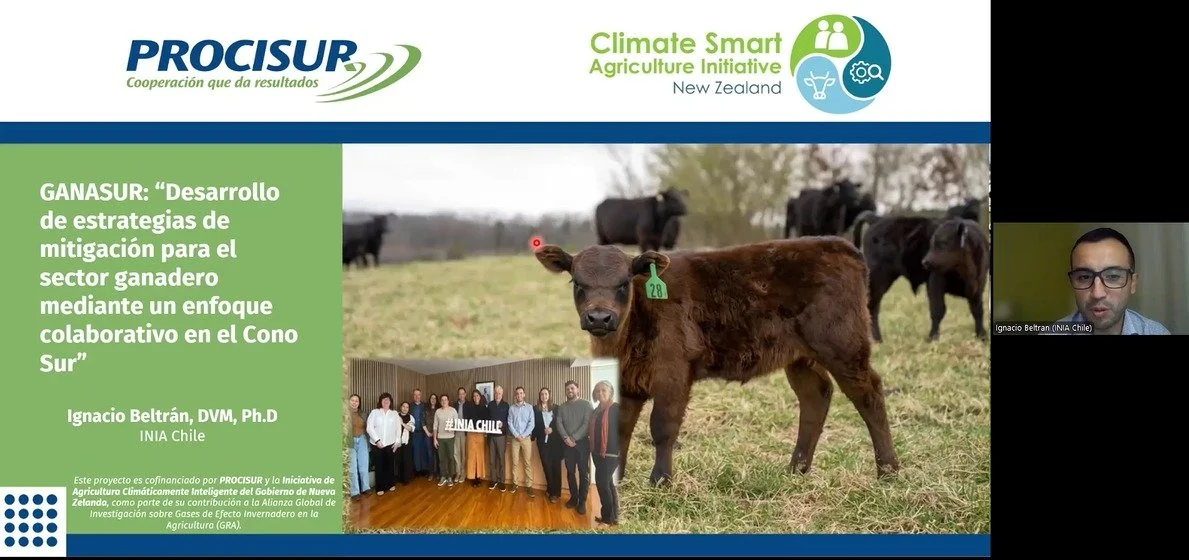
Progress on the “Development of Mitigation Strategies in Livestock Systems of the Southern Cone – GANASUR” project—co‑funded by PROCISUR and the Climate‑Smart Agriculture Initiative of the Government of New Zealand—was prominently featured at the 51st Regular Meeting of the Southern Agricultural Council (CAS) in Brazil.
The project showcased how New Zealand’s support is helping generate local data, modelling tools, and evidence-based mitigation options to reduce emissions from livestock systems across the Southern Cone. Led by Ignacio Beltrán of INIA Chile, the presentation underscored how the project’s findings can inform both public policy and on-farm decision‑making, ultimately contributing to more efficient, lower‑emissions animal production systems in Argentina, Uruguay, Chile, Paraguay, and Brazil.
Strengthening regional climate action
New Zealand’s investment in GANASUR forms part of its broader commitment to climate‑smart agriculture, supporting partner countries to develop resilient, low‑emissions agri‑food systems. The project’s progress demonstrates the value of international cooperation in generating region‑specific mitigation strategies that can be adopted by governments, research institutions, and producers.
PROCISUR’s wider 2026 agenda
During the same meeting, PROCISUR outlined its priorities for 2026, including work on its 2027–2030 medium‑term plan and the renewal of its cooperation agreements. PROCISUR emphasized the opportunity to align its research agenda with the updated strategy of the Inter-American Institute for Cooperation on Agriculture (IICA) and with CAS, supporting public policies with strong scientific evidence.
A climate outlook report for the Southern Cone—presented by Pablo Mercuri of INTA Argentina—highlighted the likelihood of diverse climate scenarios and potential water deficits affecting agricultural regions in Chile, Paraguay, Argentina, Uruguay, and Brazil. The report also identified expected climate impacts on agri‑food systems across the region.
Additional regional cooperation
CAS members also agreed to contribute a research component to a new regional project on fruit fly control, addressing a priority pest for Southern Cone countries.
As the ministerial forum that coordinates agricultural cooperation among Argentina, Bolivia, Brazil, Chile, Paraguay, and Uruguay, CAS continues to play a central role in guiding regional responses to climate and production challenges—with New Zealand’s support contributing directly to this shared progress.
See original article in Spanish here.