Colombia Strengthens Greenhouse Gas Inventories through the NZ-backed Training
Bogotá, Colombia
Colombia is strengthening its national capacity to measure and report greenhouse gas (GHG) emissions from agriculture and land use through a training initiative implemented in partnership with the New Zealand Government and the Alliance Bioversity International and the International Centre for Tropical Agriculture (CIAT).
The initiative is funded through the New Zealand Government’s Climate Smart Agriculture Initiative as part of its contribution to the Global Research Alliance on Agricultural Greenhouse Gases (GRA) and the Alliance Bioversity & CIAT through funding from CGIAR Climate Action and Scaling for Impact Science Program.
At the heart of the programme is a series of targeted technical workshops designed to enhance Colombia’s national greenhouse gas inventory for the Agriculture and Land Use, Land‑Use Change and Forestry (LULUCF) sectors. These sectors are central to Colombia’s climate mitigation efforts and to the country’s commitments under the Paris Agreement.
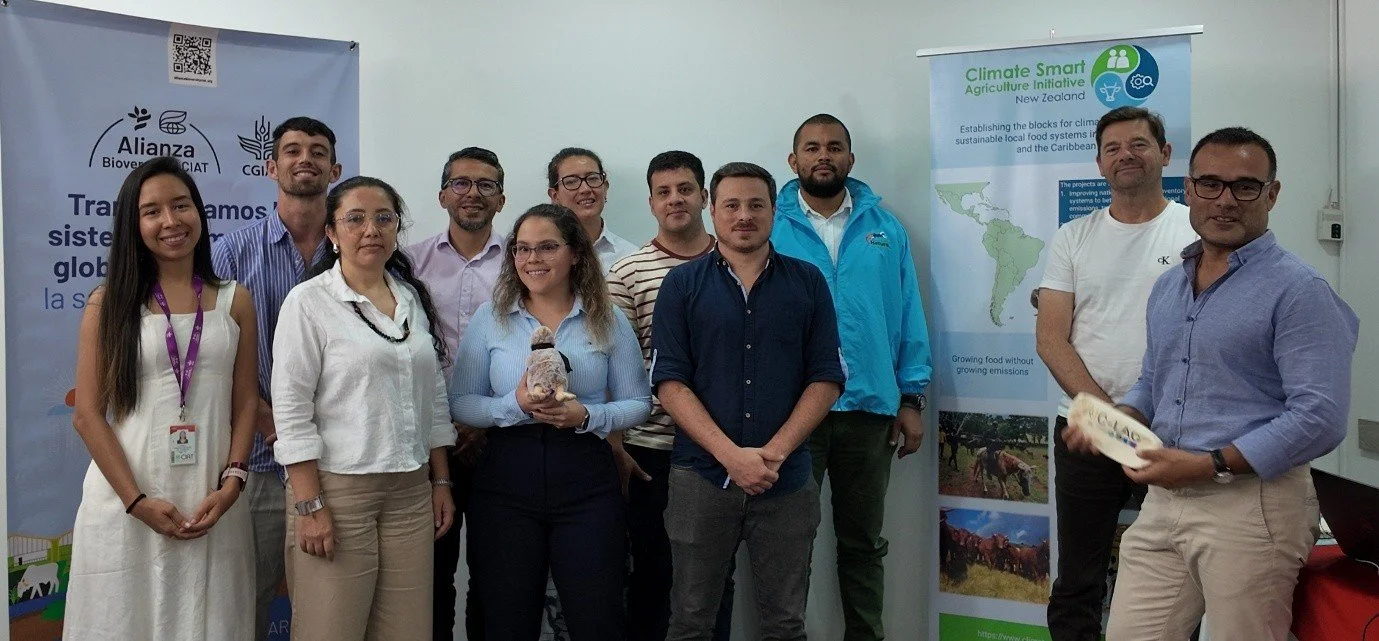
Photo from left to right: Daniela Vásquez, Connor Hynes, Ivon Casallas, Leonardo Pineda, Daniela Bernal, Laura Aranguren, Juan Pablo Castaño, Nicolás Costa, Manuel Valencia Lee Nelson and Augusto Castro.
Building technical capacity where it matters most
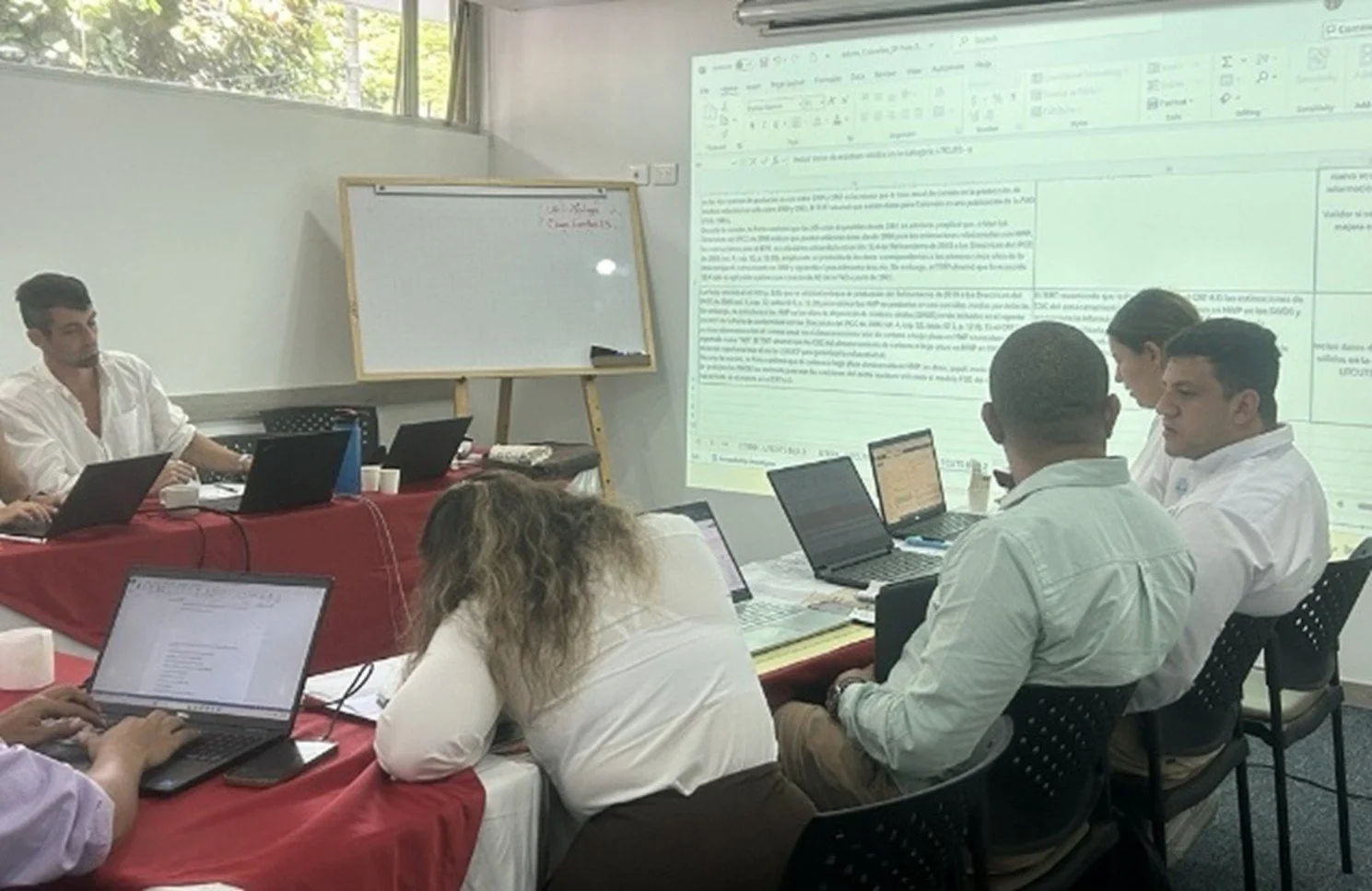
The training focuses on strengthening the ability of national technical teams to produce more accurate, transparent, and robust estimates of greenhouse gas emissions and removals. Delivered in collaboration with Colombia’s Institute of Hydrology, Meteorology and Environmental Studies (IDEAM), the programme responds directly to the country’s experience in preparing its Biennial Transparency Reports (BTRs) to the UN Framework Convention on Climate Change (UNFCCC).
Rather than offering generic training, the workshops are structured around Colombia’s real‑world reporting challenges. Participants work through practical exercises that address key bottlenecks identified in previous inventory cycles, including gaps in activity data, reliance on default emission factors, uncertainty analysis, quality assurance and quality control, and documentation practices.
This problem‑driven approach ensures that training is closely aligned with national needs and reporting timelines, supporting continuous improvement between reporting cycles as required under the Enhanced Transparency Framework of the Paris Agreement.
From inventories to climate‑smart action
A distinctive feature of the training is its emphasis on linking improved greenhouse gas inventories to climate‑smart decision‑making. By strengthening the technical foundations of the inventory, the programme helps Colombia identify priority emission sources and mitigation opportunities within its agrifood systems.
The workshops guide participants through the development of an improvement plan for the Agriculture and LULUCF sectors, setting out clear, feasible steps to move from basic (Tier 1) estimation methods towards more advanced (Tier 2) approaches for key categories. These improvements are essential for increasing the credibility of reported data and for informing evidence‑based mitigation policies.
The training also supports the translation of inventory improvements into a mitigation roadmap, helping to connect emissions data with concrete actions, investment needs, and future financing opportunities.
A partnership grounded in New Zealand expertise
New Zealand brings to the partnership extensive experience in agricultural greenhouse gas measurement, inventory development, and climate‑smart agriculture. Through the LAC Climate Smart Agriculture Programme, New Zealand supports technical cooperation that enables countries in the region to strengthen their own systems while retaining national ownership of climate reporting and policy processes.
Alliance Bioversity & CIAT, plays a central role in facilitating the training, drawing on its long‑standing engagement with national institutions across LAC. The collaboration builds on earlier regional and country‑level assessments, ensuring that Colombia benefits from lessons learned across the region while receiving tailored, country‑specific support.
Supporting Colombia’s climate commitments
By strengthening technical capacity in greenhouse gas inventory development, the New Zealand–Alliance Bioversity & CIAT partnership is helping Colombia lay the groundwork for more ambitious and credible climate action in agriculture and land use. Improved inventories enhance transparency, support international reporting obligations, and provide a stronger evidence base for national mitigation strategies.
As Colombia prepares future BTRs and advances its climate goals, this collaboration demonstrates how targeted, well‑timed capacity‑building - rooted in partnership and practical experience - can deliver lasting benefits for climate‑smart agriculture and sustainable development.
Contacts:
Nicolas Costa: nicolas.costa@globalresearchalliance.org
Lee Nelson: lee.nelson@ag-emissions.nz
Augusto Castro: Augusto.castro@cgiar.org