Vietnam Strengthens Livestock GHG Emission Management: Key NZCSA Project Outcomes
See original article
Our Partners in Vietnam, the National institute of animal science - NIAS, recently hosted a conference to present the key achievements of the NZCSA project. The project “Improving the Capacity for Inventory, Measurement, Reporting and Appraisal of Greenhouse Gas (GHG) Emissions in the Livestock Sector in Vietnam.” was funded by the Government of New Zealand. It delivered four transformative outcomes:
What were the Four Transformative Outcomes?
1. Human Capacity Development
Trained 50+ Vietnamese officials and scientists, including many young women, in GHG inventory and MRV (Measurement, Reporting, and Verification) following IPCC standards.
Built a skilled workforce capable of supporting national and provincial emission reporting.
2. Development of Advanced Tools
Created Tier 1 and Tier 2 livestock emission inventory toolkits based on IPCC 2019 guidelines.
For the first time, developed Tier 2 national emission factors for cattle and pigs, significantly improving inventory accuracy.
3. Provincial-Level Pilots
Tested MRV toolkits in multiple provinces, enabling local authorities to strengthen grassroots-level reporting and integrate emission data into planning.
4. Policy and Strategic Impact
Facilitated policy dialogues that informed Vietnam’s 2026–2030 low-emission livestock roadmap.
Established a scientific and technical foundation for circular, sustainable livestock models, opening pathways for climate-smart agriculture.
What are the Broader Implications?
These achievements go beyond technical improvements—they position Vietnam to:
Enhance transparency in national GHG reporting.
Access international climate finance by meeting global standards.
Accelerate the transition to low-emission livestock systems, supporting food security and climate resilience.
At the conference, delegates praised the project’s contributions, emphasizing the need to scale up training, research, and international cooperation to sustain momentum.
Why does this matters?
Agriculture remains central to Vietnam’s food security and rural livelihoods, yet it is highly vulnerable to climate change and contributes about 14% of national GHG emissions—with livestock being a major source. Methane (CH₄) from rumen fermentation and manure, and nitrous oxide (N₂O) from soils and fertilizers, dominate emissions in this sector. As Vietnam pursues its COP26 commitment to net-zero emissions by 2050, accurate and transparent GHG data is critical for shaping low-emission strategies.


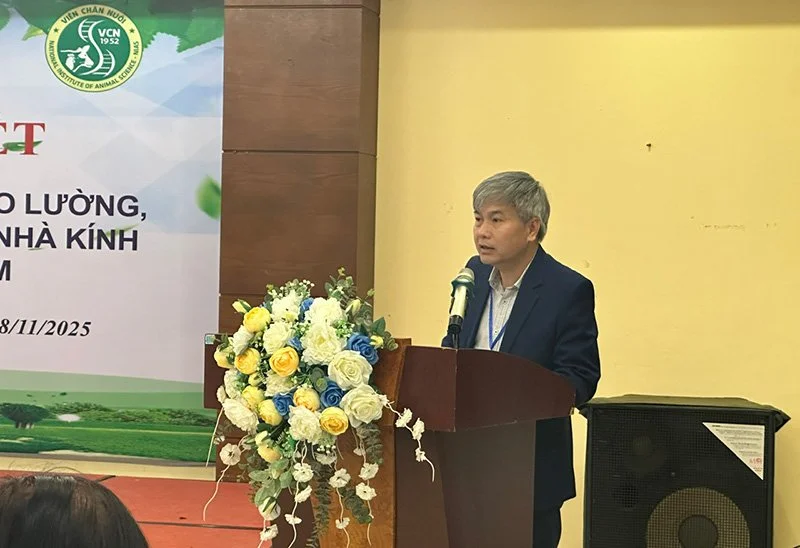
Acting Director Pham Doan Lan highlighted that the initiative not only strengthens technical capacity but also empowers young professionals to drive Vietnam’s green agriculture strategy.