Vietnamese Livestock Emissions Expert Visits MPI to Strengthen New Zealand–Vietnam Climate Collaboration

Dr. Huyen and MPI’s Nick Donald (Accelerating New Mitigations Team) discuss each countries plans for on‑farm GHG measurement.
Wellington, New Zealand —
Assoc. Prof. Dr. Le Thi Thanh Huyen, NZCSA Vietnam Lead and Senior Researcher in Farming Systems at the Vietnam Institute of Animal and Veterinary Sciences (VIAVS), has visited New Zealand to meet with climate and livestock emissions teams at the Ministry for Primary Industries (MPI), marking an important milestone in New Zealand–Vietnam cooperation on low‑emission livestock systems.
Dr. Huyen coordinated the New Zealand Climate‑Smart Agriculture (NZCSA) programme in Vietnam, which concluded in June 2025. The programme has played a pivotal role in strengthening Vietnam’s technical capacity for livestock greenhouse‑gas (GHG) measurement, reporting and verification (MRV), supporting both countries shared climate and agricultural objectives.
During the visit, Huyen and members of MPI’s climate teams discussed respective national priorities for reducing livestock emissions, shared recent policy and scientific developments, and explored opportunities for further collaboration later in 2026.
Lasting impact of the NZCSA programme
Dr. Huyen highlighted how NZCSA‑supported capacity continues to shape Vietnam’s national climate action:
Major milestone for Vietnam’s livestock inventories — A formal Vietnamese government committee is set to approve the Tier 1 and Tier 2 livestock emission factors for cattle and pigs developed under the NZCSA programme, formally promoting their nationwide use. “This marks a step change in the accuracy and credibility of Vietnam’s livestock emissions accounting,” Dr. Huyen noted.
Carbon credit pilots — Two dairy and beef cattle companies are working with VIAVS to pilot livestock emissions measurement and both wish to understand and participate in carbon credit activities by 2028, aligned with Vietnam’s carbon market roadmap (pilot phase 2025–2028; full operation from 2029).
National climate policy — VIAVS experts are contributing to the inclusion of livestock mitigation measures in Vietnam’s NDC 3.0, supported by NZCSA‑developed MRV expertise.
Ongoing research — High‑tech equipment provided by New Zealand, including a gas chromatography machine, is now being used for government‑funded research on manure management and pig diets, backed by approximately NZD 600,000 in Vietnamese public funding.
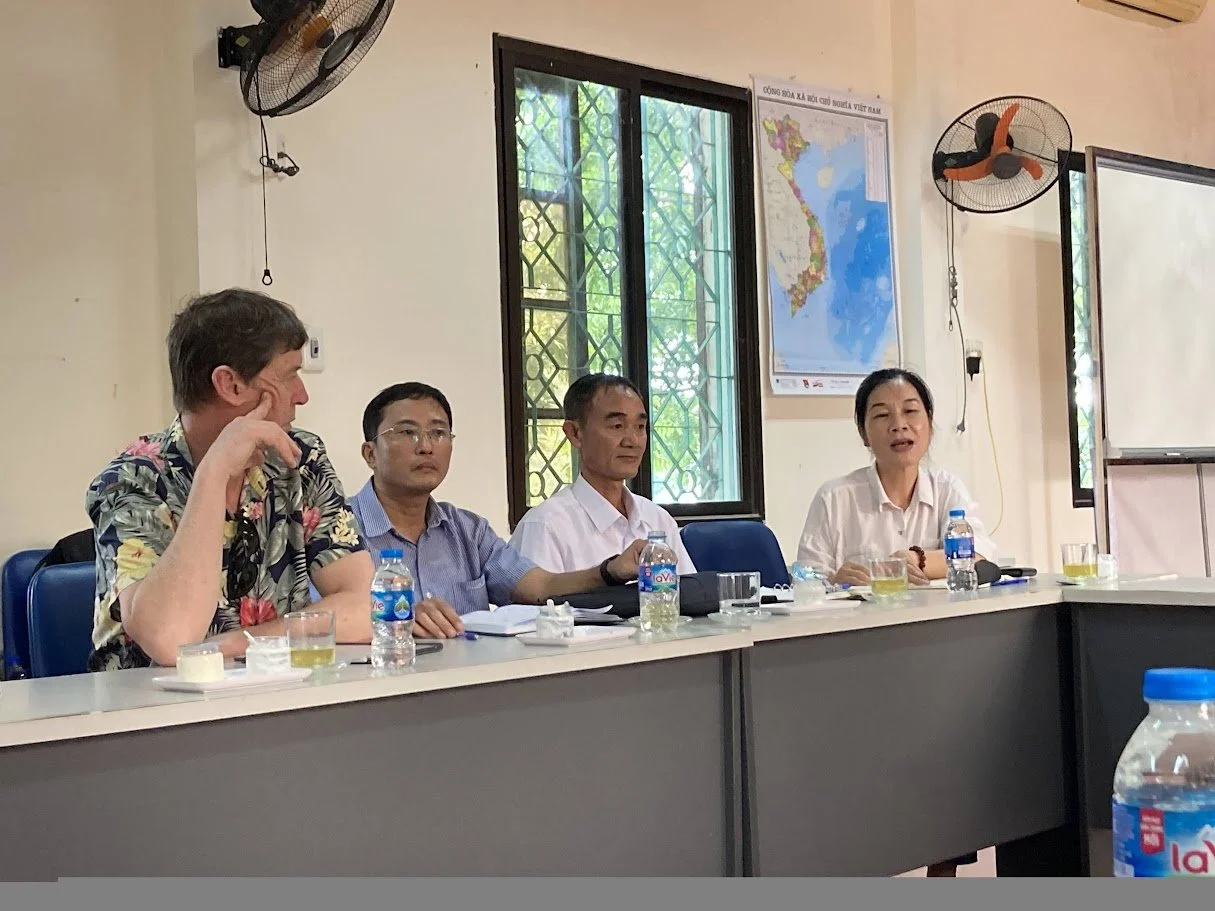
Dr. Huyen, with colleagues , explaining how the NZCSA project had positioned VIAVs to help set up Vietnams first livestock mitigation based carbon credits.
Vietnam’s shift to credible livestock emissions governance
The meetings took place against the backdrop of significant recent progress in Vietnam’s livestock emissions framework. In 2024, Vietnam issued new government circulars establishing formal requirements for measuring, reporting and verifying livestock GHG emissions. While these regulations do not mandate methane reductions at farm level ‘yet’, they represent a major shift from ad hoc approaches to a transparent, auditable national system.
“These circulars quietly unlock the most critical precondition for action — credible MRV,” Dr. Huyen said. “For the first time, livestock methane reductions in Vietnam can be measured and verified in a way that supports future policy and market mechanisms.”
This development creates new opportunities for mitigation approaches such as biogas systems, improved manure management, and feed‑based methane reduction, and lays the groundwork for linking livestock mitigation to Vietnam’s emerging carbon market.
Learning from New Zealand’s emissions strategy
MPI teams shared insights into New Zealand’s approach to tackling livestock emissions, which focuses on investment in research, innovation and emissions‑reduction technologies rather than immediately pricing agricultural emissions.
Key elements discussed included:
Farm‑level livestock emissions accounting
Strong integration of science, national emission factors and extension services
Government investment exceeding NZD 100 million in emissions‑reduction research and systems
Support for product developers through initiatives such as AgriZeroNZ, with a focus on solutions that deliver methane reductions alongside productivity gains
Discussions highlighted how some methane‑reducing feed technologies work by redirecting hydrogen in the rumen toward productive microbial processes, improving both emissions performance and animal efficiency — an area of growing interest to Vietnamese researchers working on pig and cattle diets.
Shared interests, different pathways
The discussions revealed strong similarities between Vietnam and New Zealand, despite differences in policy sequencing.
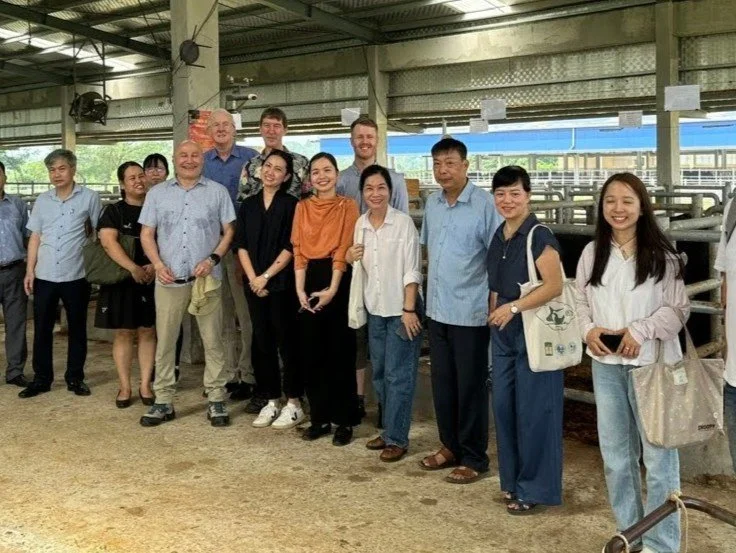
The last NZ project visit to the research facilities of Vietnam Institute of Animal and Veterinary Sciences (VIAVS), Aug 2024. NZ delegates included Matthew Johnson (MPI, Global Climate Partnerships Team), David Pacheco and Roger Hegarty (AgEC) and Sai Tongbor (MPIs Agricultural Councillor, Hanoi).
Both countries:
Prioritise strong scientific evidence
Are investing in improved emission factors and inventory systems
Recognise that farmer uptake depends on economic and productivity benefits
Key differences include:
New Zealand is further advanced in product development and commercial deployment
Vietnam is rapidly building the institutional and MRV foundations needed to support future carbon markets
Vietnam’s livestock sector includes a much larger share of smallholder and mixed farming systems, shaping how mitigation options must be designed and deployed
These differences make collaboration particularly valuable, allowing each country to learn from the other’s experience.
Future cooperation and regional leadership
MPI outlined interest in expanding collaboration with Vietnam across several initiatives later this year, including:
Regional work with SEARCA on carbon market readiness in ASEAN countries
An activity with the Global Methane Hub to share tools for emissions uncertainty analysis
Opportunities to involve Vietnam in future MPI‑supported climate and livestock programmes
Building the next phase together
Dr. Huyen’s visit underscored the strength of the New Zealand–Vietnam partnership and the role of science‑based cooperation in accelerating low‑emission livestock systems.
With Vietnam rapidly establishing credible MRV frameworks and New Zealand advancing emissions‑reduction technologies, both countries are well positioned to collaborate in the next phase — linking measurement, markets and farmer outcomes to deliver climate and productivity benefits across the region.